How to Sew Lined Curtains

how to sew lined curtains

TuffSew here, your heavy duty sewing machine manufacturer! So you want to learn how to sew lined curtains? Yeah, yeah, yeah….. we know- you aren’t looking for advice on sewing “see-through” style curtains. You landed here because you’re planning on sewing curtains with thick drapery linings.

Or, maybe you are trying to sew curtains with thick drapery linings AND an interlining!

Before we get into some tips that will help you sew curtains, linings, and interlinings – let’s talk about the applications and why it’s beneficial to install thick curtains with multiple layers.

Application #1: Blacking Out the Light

Have you ever stayed at a fancy hotel and felt the drapes? They are quite thick and do a great job keeping the light out of the room. Heck, who goes to a fancy hotel to be waken up early?

Most of the time this blackout lining is made of a synthetic material. It can be difficult for your every day household sewing machine to sew blackout lining material onto your newly chosen curtain fabric. Your normal sewing machine may skip stitches, break thread, and even break needles.

The solution is to use a heavy duty walking foot sewing machine. These machines use a larger needle, thicker thread, and a built-in walking foot mechanism to help you move the thicker fabric through the sewing process. We’ll get into the sewing machine stuff a little later..

Application #2: Keeping the Cold Out

If you want to keep your home or office warm, you’ll want to add what’s called an “interlining”  between your curtain fabric and your standard lining material. We recommend using semi-loosely woven cotton material for your interlining. This style of weave will keep out the cold air – and the cotton material creates a fluff feel to your curtains – making them feel thicker and fuller.

Make sure talk to a drapery specialist when selecting your interlining. The color of your interlining must not contrast your fabric color – otherwise it might show through and ruin the aesthetics of your curtain. Lastly, when you add an interlining….it increases the chances that your household sewing machine will falter.

Application #3: Keeping the Sound and Cold Out

For those of you who want to block out sound and cold air, you’ll need to sew-in an even thicker interlining. Some people call this type of interlining an England-Bump interlining! It’s about 2-3x thicker than standard interlinings.

We get a lot of emails from customers who struggle with these English style bump interlinings. Your household sewing machine will not hold up (most likely) when sewing three thick layers of curtain material. Our TuffSew Straight Stitch or TuffSew ZigZag is a great solution for these thick interlining applications.
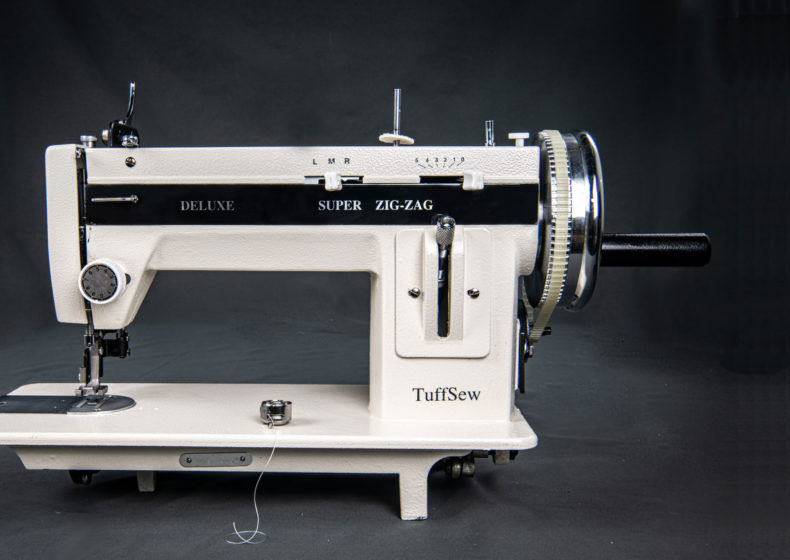
 

Here are 9 tips for how to sew lined curtains:

#1 Straight Stitching works well for curtain material. Make sure and backstitch a few times at the start and end of each length (during step #9 below) – this will assure you have a strong stitch where it counts.

#2 For heavy duty curtains (with a lining, interlining, and curtain fabric) make sure and use size 20 or 22 needle on a walking foot sewing machine. This machine uses needle type 135×17, which is much thicker than the needle on your standard sewing machine. See the video below for the needle demonstration.

#3 Give The Thread Exchange a call to learn more about which type of thread to use with your particular sewing machine. Let them know what type of material your curtains, interlining, and lining are made of. Also, let them know which sewing machine you plan on using. If you are using our TuffSew Straight Stitch, we recommend you use nylon bonded 69 thread.

#4 Always wash, dry, and iron your fabric – you don’t want any dreaded wrinkles showing up after you hang your new curtains.

#5 For heavy duty lined curtains, add two extra inches to the width of your curtain fabric. Add 7 extra inches to your length measurement. This gives you room for your doubled folded hems.

#6 Never cut the lining larger than it needs to be. Always cut it the exact length and width you want your final curtains to be.

#7 Use sewing pins when making your hems. This will keep your fabric in place. Make sure and tuck the lining(s) under the hems, using these sewing pins as needed.

#8 Use a thread color that matches your fabric.

#9 Stitch the top hem first, and then the side hems from the top to the bottom. Fold over the bottom hem, and stitch it down.

If you are thinking of using a walking foot sewing machine for your heavy duty curtains….click to learn more by watching the videos below.

Video 1 – Differences with a standard sewing machine and a walking foot machine:

Video 2: More differences from your standard sewing machine:

If you have any further questions regarding how to sew curtains… please email us at [email protected]

How to Sew Neoprene Fabric

how to sew neoprene fabric
TuffSew here, your heavy duty sewing machine manufacturer! So you want to learn how to sew neoprene fabric?  Or maybe you just want to learn a little more about the spongy material. Whatever your reason, you’ve found the right article. Neoprene is a type of synthetic rubber material which is normally sandwiched between polyester fabric. It’s incredibly difficult to sew with any sewing machine.  But we find when a Oversized Handwheel is equipped on a walking foot machine, it improves your chances of sewing neoprene. The reason why is because it slows the sewing speed down by 50% – and at a slower speed the needle doesn’t heat up as quickly. 

Neoprene Basics

It holds it’s shape very well under high and low temperatures. It’s also a flexible material, which is why many garment manufacturers are starting to use it. Some of the neoprene sewing applications we see include laptop or tablet sleeves, mouse pads, wetsuits & other garments, beverage insulators, and more. The most common question we hear at TuffSew is “Can my standard household sewing machine sew my neoprene fabric?” and/or “How many mm of fabric will my standard household sewing machine be able to sew?” All good questions. Your standard home sewing machine will be able to sew up to 2-3mm of total neoprene thickness. For example, if you are making a neoprene swimsuit that is only 2mm thick…your home sewing machine should be able to handle the job. If you are sewing neoprene materials which are more than 3mm thick, you’ll need a portable walking foot sewing machine This type of sewing machine has a motorized built in walking foot mechanism. Using a sewing machine with this type of mechanism is best because it pulls the fabric through the sewing process from the top. In conjunction, the gripped style feed dogs in a walking foot sewing machine pull the fabric from the bottom of the material. This top/bottom pull action gives you an ultimate feeding capability when you are sewing neoprene or other heavier type materials. 

The Top 5 Reasons Purchase a Portable Industrial Sewing Machine

Tuffsew here, your heavy duty sewing machine manufacturer. Are you looking for an upgrade to your household or heavy duty sewing machine? In this article you will learn the top 5 reasons why you should consider purchasing a portable industrial sewing machine. And here are the reasons:

Power and Strength

You get the power of an industrial sewing machine and the versatility of a household sewing machine. You won’t need a table and a mounted motor. This portable walking foot industrial sewing machine will sit on any flat surface and the motor is attached to the backside of the machine. This TuffSew Straight Stitch machine features a geared belt pulley drive giving you more penetration power! No more slipping! Here is a video which speaks to this upgraded belt pulley system: 

Built in Walking Foot Capability! 
The built-in walking foot on a portable industrial sewing machine makes this machine superior to any household or industrial strength sewing machine. This walking foot grabs the material from top and bottom, which relieves pressure on the needle assembly. 

You are going to get twice the feed because you have twice the grab. This walking foot assembly is motorized, so it will always go with the flow of your sewing speed! Do not be fooled into purchasing a household or industrial strength sewing machine with a walking foot attachment. 

These are two totally different sewing machines. Here is a video which speaks to the advantages of a walking foot sewing machine: 


Portability!

There are thousands of customers a year that purchase this type of sewing machine. One of the main reasons is because it’s “portable”.  You can take this machine on and off your boat. You can take it on a camping trip, on summer sports trips, and many more places. Just grab the machine on the underside and move it. It is about 35 pounds, so expect a little bit of a workout.

Durability! 

This type sewing machine is made with all metal parts and cast iron construction. You won’t have to worry about plastic gears breaking or cracking over time. Just keep your machine oiled up every couple months, and it will last you many, many years! You can feel comfortable sewing twice the material without damaging the gears with a portable industrial sewing machine.

Needle Size Capability! 

The needle on this sewing machine looks like a small nail. It’s 135×17 design type will penetrate even the thickest fabrics. With sizes ranging from 18 to 23, you’ll be certain to have a thickness that will tackle your project.

For more information, click to learn more about this Portable Industrial Sewing Machine.

The TuffSew Team

What Tools Do I Need to Sew Canvas for Boating Projects

how to sew canvas

Before you start diving into do-it-yourself canvas sewing work on your boat- you need to make sure you have all the right tools for the job. You are going to need a heavy duty sewing machine, some thick needles, some thread, a good pair of scissors, and material. 

You don’t need to be alarmed and go buy a $1,200 dollar sewing machine. A simple walking foot sewing machine with a built in motor will do.

We recommend our TuffSew Straight Stitch 9” heavy duty walking foot sewing machine for all of your sewing projects. There are two different size TuffSew Straight Stitch machines. One has a 7” gate the other has a 9” gate. The gate is essentially the amount of horizontal working space from the left edge of the sewing machine to middle base of the machine. 

We strongly encourage you to use a machine with a longer 9” base-it will certainly make things easier on your when sewing canvas. To learn more about this sewing machine, please click on the video below:
 
http://www.youtube.com/watch?v=HN-ewDgw8V4
 
Let’s get to material. You have primarily 2 choices at this point. You can go with the standard in the industry “Sunbrella” which is acrylic – or natural canvas. We do recommend using Sunbrella however the price is 2-3 times higher than natural canvas.

Next on to the recommended thread! If you are new to sewing it’s important to use the same color thread as your material. You certainly don’t want to show off your errors. Light colored thread on top of dark material does look fancy- if you are up for the challenge. 

The type of thread you want to use is polyester based 69 or 92 weight. A simple google search will place in on websites where you can order all different colored threads for your particular project.

Needles and the correct sewing machine are next and the most important topic on this article. The following hypothetical situation happens daily… So you are excited….let’s say you bought your Sunbrella material, bought a great pair of new scissors, and bought your brand new 69 colored thread. 

You wake up early one Saturday and take out your regular household sewing machine and needles. You start to sew…but the needle not only won’t penetrate ¼” thickness of material, and the needle starts bending and then they keeps breaking. DON’T PANIC! It’s not you.

You just need to realize you are not using the correct sewing machine and needle. You need to use a 135×17 needle size 22. These needles are like nails and will penetrate up to 3/8” thickness of canvas. 

You also need a walking foot industrial style sewing machine to hook these needles into. Once you have the right sewing machine and needles….your sewing project will come alive.

It’s important to find a heavy duty walking foot sewing machine for sewing canvas. Click to learn the other benefits to using the TuffSew Walking Foot Portable Industrial Sewing Machine.

As always, if you have any further questions- please don’t hesitate to email me at [email protected]. I get back to all emails within 24 hours.
-The TuffSew Team-