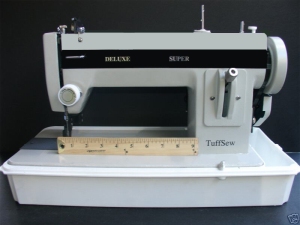
TuffSew here, your heavy duty sewing machine manufacturer! So you want to learn how to sew neoprene fabric? Or maybe you just want to learn a little more about the spongy material. Whatever your reason, you’ve found the right article.Neoprene is a type of synthetic rubber material which is normally sandwiched between polyester fabric. It’s incredibly difficult to sew with any sewing machine. But we find when a Oversized Handwheel is equipped on a walking foot machine, it improves your chances of sewing neoprene. The reason why is because it slows the sewing speed down by 50% – and at a slower speed the needle doesn’t heat up as quickly.
Neoprene Basics
It holds it’s shape very well under high and low temperatures. It’s also a flexible material, which is why many garment manufacturers are starting to use it.Some of the neoprene sewing applications we see include laptop or tablet sleeves, mouse pads, wetsuits & other garments, beverage insulators, and more.The most common question we hear at TuffSew is “Can my standard household sewing machine sew my neoprene fabric?” and/or “How many mm of fabric will my standard household sewing machine be able to sew?” All good questions.Your standard home sewing machine will be able to sew up to 2-3mm of total neoprene thickness. For example, if you are making a neoprene swimsuit that is only 2mm thick…your home sewing machine should be able to handle the job.If you are sewing neoprene materials which are more than 3mm thick, you’ll need a portable walking foot sewing machine. This type of sewing machine has a motorized built in walking foot mechanism. Using a sewing machine with this type of mechanism is best because it pulls the fabric through the sewing process from the top.In conjunction, the gripped style feed dogs in a walking foot sewing machine pull the fabric from the bottom of the material. This top/bottom pull action gives you an ultimate feeding capability when you are sewing neoprene or other heavier type materials.
Tuffsew here, your heavy duty sewing machine manufacturer. Is portability something that is important to you with your next sewing machine purchase?
Do you need a machine that is more powerful (for sewing thicker/coarser materials) than a regular household sewing machine? If yes, our TuffSew Straight Stitch Industrial Portable Sewing Machine may be right for you!
Why is this sewing machine a great choice for your next heavy duty sewing project? Well, here is the TOP 5 Reasons:
5) Portability!
Our TuffSew Straight Stitch machine comes equipped with a motor that is built onto the back of the machine. Regular industrial sewing machines (ones that cannot be moved very easily) need to be used in a sewing machine table with an under mount motor. Our TuffSew industrial portable sewing machine has an advantage here if you need to take the machine on your boat, to your workshop, on the road, etc. Just make sure you can lift approximately 35 pounds 🙂
4) Built-In Walking Foot Mechanism!
Our TuffSew Straight Stitch is designed with a built-in walking foot mechanism. This is very different that most walking foot attachments that only snap-on regular household sewing machines. This built-in walking foot mechanism will evenly feed your material as it grabs (with its traction like grip) the top of your material. This built in walking foot works in conjunction with the feed dogs which pull the bottom piece of the material through the sewing process.
3) Cleated Positraction Belts!
The TuffSew Straight Stitch has an upgraded belt system. Our belts are cleated, which eliminate slippage. The pulley that our belt sits in is geared, which eliminates slippage even further. It is very important to use this type of belt system when sewing heavy duty fabrics like leather, canvas, and vinyl. Other sewing machines use belts and pulley systems without gears or cleats. This creates slippage and doesn’t allow you to sew heavy duty fabrics. Here is a video for you to learn more about this upgraded belt system:
2) Thicker Needle Capability Designed for Heavy Fabric!
You can put up to size 23 needle into this industrial portable sewing machine. Size 23 needle looks like a thick nail – it’s super heavy duty. Regular household sewing machines only allow you to use up to needle size 19. You cannot properly penetrate heavy fabric with a size 19 standard needle. Scroll to minute 2:15 on the below video to learn more about why using thicker needles is important when sewing heavy duty fabrics.
1) Larger Thread Capability!
If you are using an improved walking foot, improved belt system, and thicker needles….doesn’t it make sense that you should be able to use heavier duty thread? The TuffSew Straight Stitch can use up to size 69 nylon bonded thread. This thread is much thicker and heavier for all your HD sewing needs.
If you have any questions about the TuffSew industrial portable sewing machine, please email us at [email protected]. We also consult on applications, so feel free to let us know about your upcoming project. -The TuffSew Team-
Tuffsew here, your heavy duty sewing machine manufacturer. If you are landed on this article, you are probably an outdoor enthusiast looking to make or repair your own gear. I don’t have to tell you that it’s a great feeling telling your friends that you “did it yourself”.
Before creating TuffSew.com in 2003, I was in the sewing business for over 35 years teaching and educating those who wanted to learn how to use a sewing machine.
Over the years I received many questions on sewing heavy duty material including nylon.
In this article, I will go over a few tips that will help you tackle your heavy duty nylon projects.
How to Sew Nylon Materials
Selecting the Correct Sewing Machine
The first, and most important, part of sewing nylon is to select the correct sewing machine. If you are sewing multiple layers of nylon material you’ll want to use a semi-industrial or industrial sewing machine. More specifically, a walking foot portable industrial sewing machine.
When sewing multiple layers, a built in walking foot helps grab your material from the top and the bottom- efficiently pulling your material evenly through the sewing process. Click the video below to learn more:
Small Details Make a World of Difference
Make sure your sewing machine is cleaned and oiled.
I also recommend you use a size 22 needle (one that’s new and sharp). You should be able to comfortably sew 1/4″ thick (or a tad more) with either a straight stitch or zigzag walking foot sewing machine.
Moving on to thread- very important. When you are sewing heavy duty fabric you are going to need stronger thread.
I would recommend you use nylon bonded (funny eh) #69 thread. Another reason I recommend you use a heavy duty walking foot sewing machine is because bobbin cases on a standard home sewing machines do not allow for the extra thickness of thread. You’ll just keep on getting those rats nests.
Now that you have the right tool for the job- make sure you start off slow. Practice, practice, practice. Use some old scraps of material to get warmed up for your big job.
Make sure your foot pedal works fast and slow. Nothing is worse than using a sewing machine that can’t slow down due to a 1960’s foot pedal.
Well there you have it- I hope I could help get you started with your current nylon sewing project.
Like I said, I’ve been in the sewing industry for over 35 years. If you have any further questions, please don’t hesitate to email me at [email protected].
TuffSew here, your heavy duty sewing machine manufacturer! So you want to learn how to sew a backpack? Maybe you just want to learn more about Cordura materials? If yes, you found the right article.
The first backpacks of our time were made of “cotton canvas” material waterproofed with wax coating. The problem with this was the material combination was very heavy. Also, the waterproofing was inadequate.
One of the reasons backpacks were made of cotton canvas was the fact that they were very inexpensive to produce.
This low cost to build quickly translated poor quality and low durability.
Today, if you are looking to manufacture a quality backpack…you’ll want to use Cordura or Kodra fabric. These fabrics have a rough fuzzy texture and used in all high quality backpacks. Compared to normal canvas, the Cordura is very lightweight and abrasion resistant.
Compared to cotton canvas, polyurethane coated Cordura or Kodra is waterproof. You could use a nylon weave, but they are much heavier and not sought after as much in the backpack industry.
When looking for a superior strong, resistant to tearing and durable backpack, you should definitely consider military tactical backpacks. they can be made of both: Cordura or Kodra fabric.
Other advantages with Cordura is resistance to tearing and scruffing. Intense backpackers travel next to trees, brush, and rocks. They appreciate the durability of the waterproof travel backpack Cordura fabric and will spend extra money on a quality made backpack that will last them several years.
In terms of lifetime usage, overtime the polyurethane coating will eventually wear down. This is due to sunlight, exposure to water/salt water, chemicals used in cleaning, and storing the backpack in a damp area.
Advise your customers to completely dry off the backpack before storing it. There are several quality levels of Cordura, so do your homework and find one that may be guaranteed of the weardown of it’s coating.
Now that you’ve selected Cordura or Kodra to be your material for your backpacks…..what sewing machine should you use to stitch it up?
Here are 5 tips for sewing cordura:
1) Look into a built-in walking foot sewing machine.
Our TuffSew Straight Stitch and TuffSew ZigZag are heavy duty, semi-industrial type sewing machines. Using a sewing machine with a built in walking foot is best because the walking foot is motorized and pulls the fabric through the sewing process from the top of the fabric. In conjunction, the gripped style feed dogs in a walking foot sewing machine pull the fabric from the bottom of the material. This top/bottom pull action gives you ultimate feeding ability when you sew Cordura or heavier type materials. With a built-in walking foot sewing machine, you can sew many layers up to 1/4″-5/16″ thickness. Here is a picture of this portable walking foot sewing machine and a true built in walking foot (the top portion):
For best results, do not use a standard household sewing machine when sewing layers of Cordura for backpacks. These sewing machines use a walking foot attachment. Below is an picture of a walking foot attachment. This is what you DON’T want to use if you are sewing Cordura or Kodra fabrics. You won’t be able to sew more than 1 or 2 layers.
2) Make sure and increase your stitch length to the maximum while you are sewing.
Some walking foot machines have a 5mm stitch length, others might have a 5.5mm or 6mm stitch length.
3) Use the largest size needle available.
With most walking foot sewing machines, you can use up to size 21 needle.
4) Ask for a “slow” type foot pedal (some call it a carbon-elemented foot pedal).
This will be a big advantage when sewing layers of Cordura. Take your time for best results.
5) Use a heavier type thread.
Another great reason for using a walking foot sewing machine. Standard sewing machines can’t handle nylon bonded size 69 thread…but a true walking foot sewing machine can.
Lastly, if you want to learn why an industrial portable walking foot machine has advantages over a standard sewing machine…see this video:
Also, here is a video on the belt pulley system advantages these walking foot machines have:
If you have any further questions regarding heavy duty sewing… email us at [email protected]